Tag: Writing

Procedural Writing

LI: To write a set of clear instructions that show how to make a hangi.

  • Equipments
  • volcanic stones
  • shovel
  • paper
  • lighter
  • twigs/kindling
  • cloth sacks
  • metal basket (cooking tray)
  • hook tool
  • gloves
  • cylinder of water
  • leaves


  • Ingredients
    • vegetables (cabbage, potatoes, carrots, taro leaves, kumera, pumpkin)
    • meat (ox, chicken, beef, lamb, pork)
    • Stuffing.

Steps:

  1. Dig a hole that is at least 4 ft deep
  2. Once your done digging the hole, gather lots of twigs and some flat stones and  rough stones 
  3. Find baskets that are made out of metal or cooking trays.
  4. Make sure that the hole can fit more than 2 baskets of food.
  5. Flatten the stones on the bottom of the pile of wood that can make fire lite. 
  6. Lighten the wood in between the wood.
  7. Let the fire light for 3 hours. For then add the meat and the vegetables to the basket.
  8.  Peel or cut the vegetables while the fire is burning the wood.
  9. Place the meat in the Hangi.
  10. Place the foil on the basket or leaves like taro or banana leaves.
  11. Place the meat inside the basket make sure the meat and vegetables are in a different basket because if the vegetables are with the chicken it is most likely for the chicken to be raw and when u eat raw chicken you most likey get food poisoning
  12. When the stones turn red, place the stones in the pit. 
  13. Wet the sacks or clothes and wet 1 or more sheets. 
  14. Place it gently on top of each other.
  15. Place the basket of food on the hot stones.
  16. Place the wet sheet on top of the basket of foods.
  17. Use the wet sheets to cover the food so the food doesn’t have dirt on it.
  18. Cover the pit with dirt when the sheets and sacks are covering the food.
  19. Wait after 3 hours and remove the dirt slowly.
  20. Peel the wet sacks and sheets off the food.
  21. Remove the baskets of food. (Always wear gloves while doing this step.)
  22. Take the food out.

Safety Message for Hangi: Always keep an eye on the Hangi so it doesn’t burn the food, places, or trees. (Make sure that the Hangi is not near buildings.) Never let it sit by itself.

Today we unpacked how to follow and write a set of instructions. To do this effectively your instructions need to be explicit and the steps to follow ordered. Each step begins with an instructional verb and should be written in a way that is easy to understand,

I enjoyed the video about the hangi because I learnt about, what a hangi is and what they do. My goal for next time is double check on my work to see if it has instructional verb. To achieve this I will need to learn more about procedural text and become better at it.
Aretha Franklin Song Respect

LI: Research Aretha Franklin’s song RESPECT.

Aretha Fanklin was born in 25 March 1942 and 1960 is got her first hit song when she was 18. Aretha Franklin is a singer/artist. She makes many songs, but one of the songs we are forcing on was RESPECT. The reason we are forcing on the song RESPECT is because one of the CARE awards is respect. One of the facts I wrote was that: she won 18 grammys, and 122 singles. One of the lines of the song RESPECT is “R-E-S-P-E-C-T, take care, TCB.” TCB means taking care.

I found this activity diffcult because I never knew about Aretha Franklin, but I knew her song RESPECT.

Thank you Letter

LI: Write a thank you letter to a teacher or staff member.

Writing thank you letters shows your greatfulness to the person your writing to. There is always a meanings to behind the thank you letter. My thank you letter meaning is that I’m greatful she made food for us and help us at camp. For example the meaning for my thank you letter is: Thank for taking LS2 on hiking and taking helping our teachers take us to camp. I enjoyed the time with you in LS2 and I appreciate the time you been kind to LS1 by laughing at jokes, watching movies with us, and other things you did for us. 

I found this activity tough because camp had lots of people helping and it was hard to chose.

Key Competencies

LI: To create a comparison of the before and after experiences at camp

Before camp, we wrote down what we would achieve at camp by using the acronym TRUMP. The meaning of Trump is thinking, relating to others, participating and contributing, using language, symbols and text, and managing self. These 5 words help us to remember when to use them in every activity. When we came back from camp, we wrote down how we used the key competencies for our belongings and in the activities. 

I found this activity challenging because this is relating to myself and what I did at camp.

Explanation Writing

LI: To understand the structure and language features in an explanation

How did Goldilocks upset the Bear family? 

To upset people is by doing things that are disrespectful to them. For example: hurting them emotionally and physically. In the fairytale Goldillocks and the three Bears, Goldilocks makes some upsetting decisions. Have you ever made anyone upset in this way?

Goldilocks felt the urge to do something cruel, then found an abandoned house. She felt insecure by trespassing, but also wanted to know what she could explore inside. Her curiosity grew bigger and bigger as she walked inside, however her actions always would have a way of coming back.

Her savage actions ended up destroying the house leaving no sign of respect. Throughout the story, Goldilocks’ level of respect enlarged as we readers wanted to question her behaviour. Do you think that this disrespect shows her true self?

Disrespecting other people’s property shows a huge sign of irresponsibility. The owners would come back seeing a pigsty and a selfish regretting little girl who didn’t know that her actions would always have a way of coming back to her.


To help us understand how to write an explanation we looked at the purpose, the structure (what it looks like) and the language features. An explanation tells us how or why something is the way it is. We look at the 3 sentenses, past tense, present tense, and future tense. The structure of an explanation is TIIC, title, introduction, information, and conclusion. The title is identifying the topic. Introduction is explaining about the topic, and writing a question that makes the people think. Information is telling what happens, the sequence, cause and effect. Conclusion is making connections and answering the question from the title. To help us understand this we learnt about cause and effect. Cause and effect is an action and a reaction. We used the story of Goldilocks and the 3 Bears to help us understand this. Here is our explanation that describes how Goldilocks upset the Bear family. 

This activity was fun because I got to revise how to write an explanation.

Writing – Writing a Story

I created my own story about McDonalds and Burger King.

First I brainstorm and planned out my story about McDonalds vs Burger King. The front cover and the back cover we had to illustrated.

Next we wrote our story. For example: They agree and go back to Burger King, so they can have a food fight. The Ronald family got hit by a whopper. There were only 5 employees, the owner, and Ronald McDonald, were still in the food fight. All the employees for both teams were out, and there were only the mascots (Ronald and the Burger King mascot), and the owners left. The mascots get out. The both owners saw the same custom, but he was going to KFC, so Burger King and McDonalds quit the food fight, teamed up, and went to KFC, so they could have another food fight.

I enjoyed this task because I made my own story. I need to improve on writing the plan. I did well on writing my brainstorm.


Writing – Narrative Planner

Narrative structure is TOPES. Title, Orientation, problem, events, and solution.

Title is the storys title. For example: Goldilocks. Orientation is explaining the first part of the story. For example: Goldilocks goes around the woods and finds a house. Problem is revealing the cause for the main character or what they are doing. For example: The house was owned by 3 bears, but goldilocks didn’t know and entered the house. 

Events is the main or the biggest part of the story. For example: Goldilocks eats 1 porridge, it was too small, and too cold. Then she eats a medium porridge, it was too hot, and the porridge wasn’t big enough. Last, Goldilocks ate another porridge and it was just right. Solution is the end of the story. For example: She runs all the way back home.

Topes can be only used in Narrative writing.


Writing – Commanding Conversation

I learnt how to write conversation.

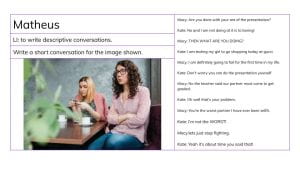
First I found a photo. The photo looked like 2 girls, but 1 is not talking to the other.

Next I thought about what to write. This was hard because I didn’t know what to write for my conversation.

Lastly I wrote my conversation about 2 womans. This was fun to write.

I enjoyed this task because I learnt how to write a conversation. I need to improve on my conversation. I did well on finding a photo.